

Non-Volatile Hardware System Controller (NV-HSC)
Deterministic, HDL-Only Board Management for SoC’s, Versal™ and Zynq UltraScale+™ Platforms
Introduction
Modern FPGA and adaptive SoC platforms rely on complex, software-driven system controllers to manage power, configuration, and board-level monitoring. While flexible, these approaches introduce additional layers of additional complex and expansive FPGA, software design, boot dependencies, and non-deterministic behavior that can complicate system design—especially in high-reliability and safety-critical environments.
The Non-Volatile Hardware System Controller (NV-HSC) presents a fundamentally different approach. Implemented entirely in hardware using synthesizable HDL on Low Cost Non-Volatile FPGA, NV-HSC eliminates the need for embedded processors, operating systems, and firmware. This enables deterministic, instant-on operation with significantly reduced system complexity and system cost.
By combining power management, monitoring, board configuration, and real-time status indication—including integrated OLED display support—into a single non-volatile FPGA solution, NV-HSC provides a compact, low cost, robust, and certification-friendly alternative to traditional system controller architectures.
Overview
The NV-HSC is a pure hardware (HDL-only), non-volatile FPGA-based System Controller that replaces traditional software-driven management solutions used on modern FPGA and adaptive SoC platforms.
Designed as a drop-in alternative to the software-based System Controller architecture used on boards with AMD Versal Adaptive SoC and Zynq UltraScale+ MPSoC, NV-HSC delivers:
-
Instant-on operation (no boot time)
-
Deterministic behavior
-
Zero software dependency
-
Enhanced safety and reliability
-
Optional user proprietary logic implementation
Key Features
-
Pure Hardware Implementation (HDL-Only)
No CPU, no operating system, and no firmware required -
Non-Volatile, Instant-On Operation
Fully operational at power-up with zero boot time -
Deterministic System Behavior
Predictable, cycle-accurate control with no software latency -
Advanced Power Sequencing & Control
Multi-rail sequencing with dependency management and timing control -
Integrated Power Monitoring
Real-time voltage, current, and temperature measurement -
Hardware-Based Fault Detection & Protection
Immediate response to over-voltage, under-voltage, over-current, and thermal events -
Board Configuration Management
Clock initialization, reset sequencing, boot mode control, On Board SFP’s, SFP+ and peripheral setup -
PMBus / I²C / SPI / GPIO Interfaces
Flexible connectivity to power regulators, sensors, and board devices -
On-Board OLED Display Support
Real-time system status visualization without external tools or software -
Built-In Self-Test (BIST)
Power-up validation and continuous system health monitoring -
Highly Configurable Architecture
Parameterizable for different power trees, sequencing profiles, and system requirements -
Low Latency Hardware Response
ns–µs reaction time for monitoring and control events -
DO-254 Friendly Design
Simplified certification flow with full HDL traceability -
Enhanced Reliability & Security
Eliminates software-related failures and cybersecurity exposure -
Reduced System Complexity & BOM
Removes need for external system controller processors
High Level System Block Diagram
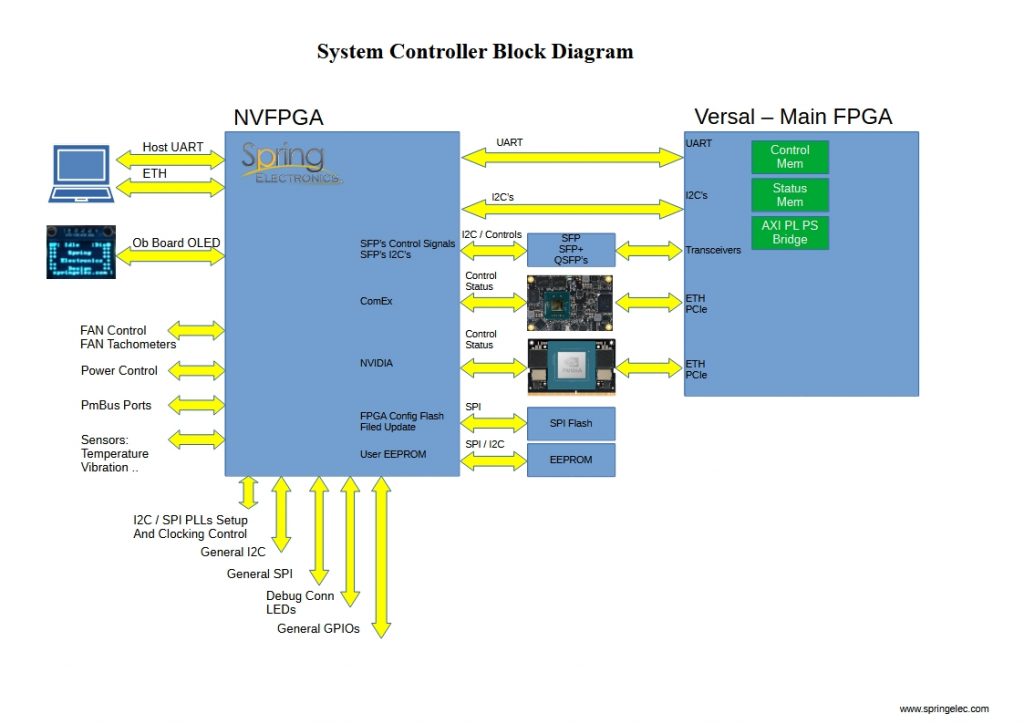
System Design Blocks
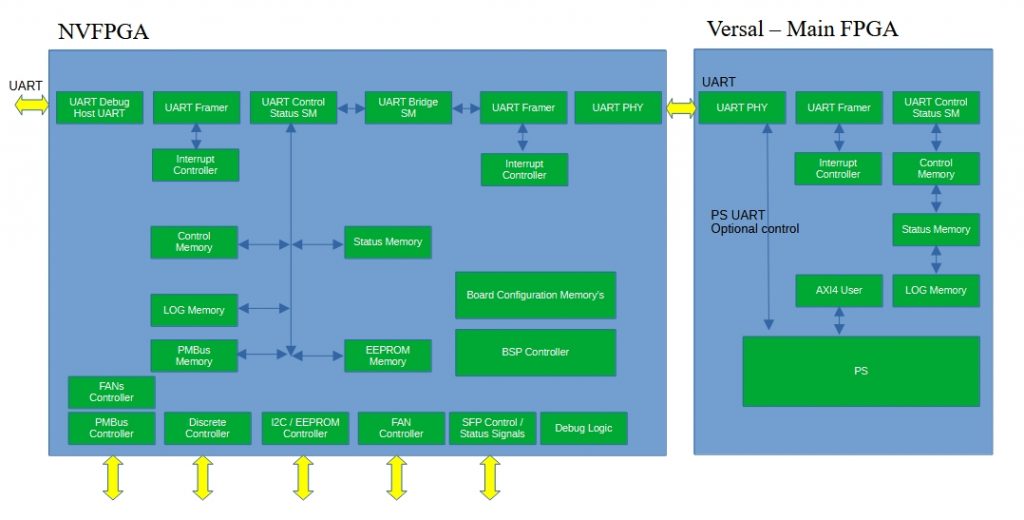
Host to NVFPGA Communications

NVFPGA Communication Negotiation
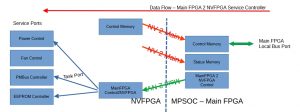
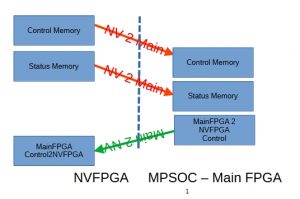
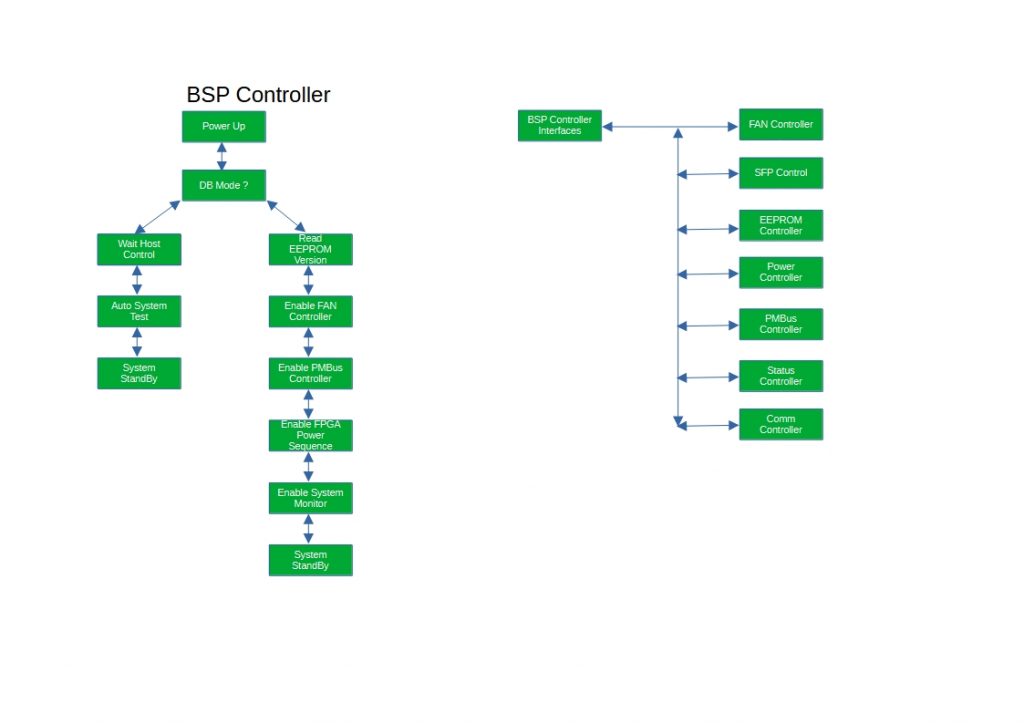
System Flow Sequence Machine
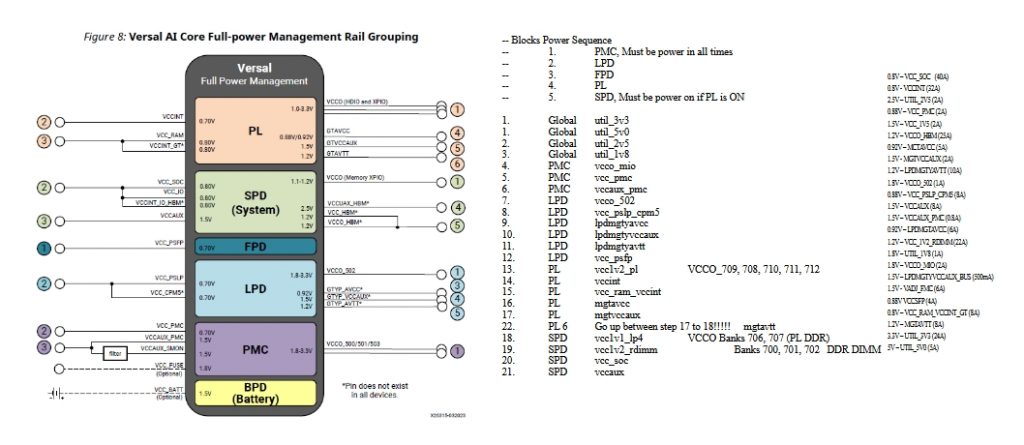
Power Rails and Live Logic Analyzer Sample
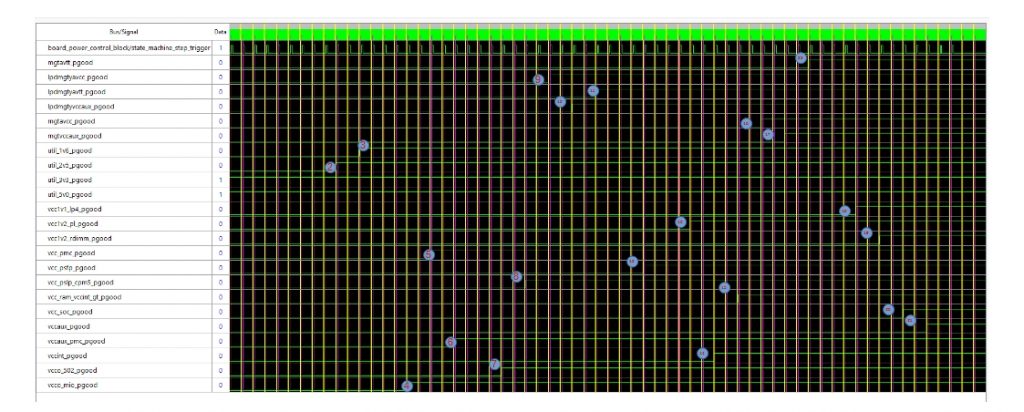
Power Control Monitor
-
Power Management & Sequencing
-
Deterministic multi-rail power sequencing (state-machine based)
-
PMBus / I²C control of digital power regulators
-
Rail dependency enforcement and timing control
-
Hardware fault shutdown (OV/UV/OC)
Monitoring & Telemetry
-
Continuous monitoring of (PmBus Controller):
-
Voltage
-
Current
-
Temperature
-
-
Threshold-based alarms and alerts
-
No polling latency (fully hardware-driven)
Board Configuration
-
Clock generator configuration (I²C/SPI)
-
Boot mode control and reset sequencing
-
EEPROM / board ID handling
-
Peripheral initialization
Integrated OLED Display (Unique)
-
Real-time board status without host or CPU:
-
Power rails
-
Temperature
-
Boot state
-
Fault conditions
-
Hardware Fault Protection
-
Immediate response (ns–µs range)
-
Autonomous shutdown / recovery
-
No firmware or interrupt dependency
Built-In Self-Test (BIST)
-
Power-up rail validation
-
Peripheral presence detection
-
Continuous health monitoring
Architecture
Traditional Approach (Software-Based)
-
External controller (MPSoC/CPU)
-
OS + firmware + applications
-
Non-deterministic behavior
NV-HSC Approach (Hardware-Based)
-
Non-volatile FPGA
-
Dedicated hardware state machines
-
Deterministic, always-on operation
Key Benefits
|
Benefit |
Description |
|---|---|
|
Deterministic Operation |
No OS, no software latency |
|
Instant-On |
Active at power-up (no boot) |
|
High Reliability |
Eliminates software failure modes |
|
DO-254 Friendly |
HDL-only design simplifies certification |
|
Cyber-Secure |
No network stack / OS exposure |
|
Low Latency |
Real-time hardware response |
|
Reduced BOM Complexity |
No external processor required |
Safety & Certification
-
Designed for safety-critical systems (DAL A/B)
-
Fully traceable HDL implementation
-
Eliminates need for DO-178 software processes
-
Deterministic behavior simplifies verification
Interfaces
|
Interface |
Function |
|---|---|
|
PMBus / I²C |
Power control and monitoring |
|
SPI |
Clocking and peripheral configuration |
|
GPIO |
Reset, enable, fault signals |
|
OLED (SPI/I²C) |
On-board display |
|
Optional UART |
Debug / telemetry output |
Implementation
-
Delivered as synthesizable HDL IP
-
Target: Non-volatile FPGA platforms (e.g., Flash-based FPGA)
-
Configurable via parameters:
-
Number of power rails
-
Sequencing profiles
-
Monitoring thresholds
-
Target Applications
-
Versal / Zynq-based custom boards
-
Aerospace & defense systems
-
Industrial control platforms
-
High-reliability embedded systems
-
AI/edge compute hardware
Comparison vs Traditional System Controller
|
Feature |
Software SC |
NV-HSC |
|---|---|---|
|
CPU Required |
Yes |
No |
|
OS Required |
Yes |
No |
|
Boot Time |
Seconds |
Instant |
|
Determinism |
Limited |
Full |
|
Safety Certification |
Complex |
Simplified |
|
Fault Response |
ms |
ns–µs |
|
User Interface |
External GUI |
On-board OLED |
Ordering / Availability
-
Product: NV-HSC IP Core
-
Delivery: HDL source or encrypted netlist
-
Customization: Available (power tree, interfaces, display)
Summary
The NV-HSC redefines FPGA board management by replacing software complexity with deterministic hardware intelligence.
A robust, secure, and certification-friendly alternative to traditional System Controller solutions.
